Finding good indoor games for children can be difficult when phones, tablets and YouTube are competing for attention every five seconds.
Board games provide a simple alternative.
They can encourage children to practice counting, memory, vocabulary, logical thinking, patience and turn-taking while playing with parents, siblings or friends.
Here are some of the best types of board games for kids in Bangladesh.
1. Ludo
Ludo is one of the easiest games to introduce to children.
Kids can learn:
- Counting
- Taking turns
- Basic probability
- Following rules
- Patience
It is also inexpensive and widely available in Bangladesh. See how it compares to a strategy-only alternative in Ludo vs Coridor.
2. Snakes and Ladders
Snakes and Ladders is particularly suitable for younger children.
The basic gameplay is simple: roll the dice, move the pieces and try to reach the final square.
Because children repeatedly count spaces, it can also reinforce basic number recognition.
3. Chess
Chess is better for children who are ready for more complicated rules.
It introduces:
- Planning
- Pattern recognition
- Logical reasoning
- Strategic thinking
- Decision making
Children do not need to become chess experts for the game to be useful. Learning to think one or two moves ahead is already a meaningful skill. A faster way to build the same skill is explained in Chess vs Coridor.
4. Connect 4
Connect 4 is easy to understand but introduces basic strategic thinking.
Players have to decide where to place pieces while simultaneously watching their opponent's moves.
It is particularly suitable for two children playing together.
5. Memory Games
Memory-based tabletop games require players to remember the locations of matching cards or objects.
These games are suitable for younger children and can be played with parents or siblings.
6. Word Games
Word games such as Scrabble can be useful for older children who are developing English vocabulary.
They combine language learning with competition.
7. Educational Mathematics Games
Math-focused board games can help children practice numbers, addition, subtraction and basic arithmetic.
These are particularly useful for parents looking for alternatives to worksheets.
8. Strategy Games
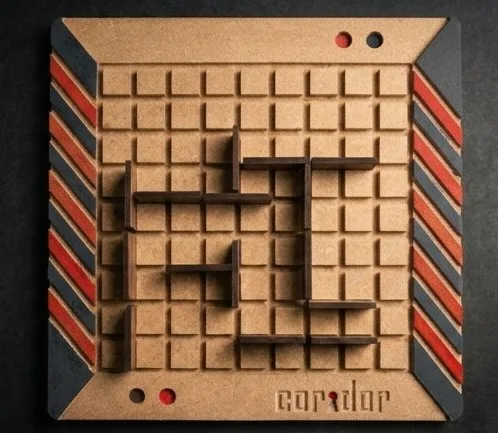
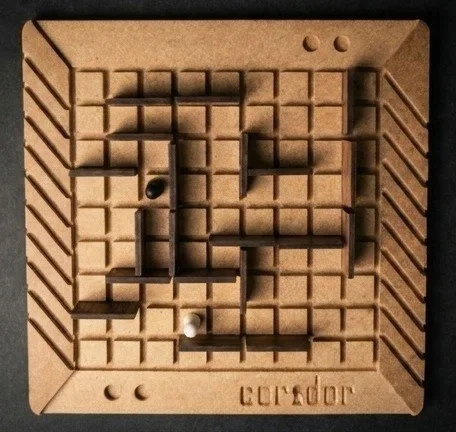
Older children can gradually move from simple games to strategy-based games such as Coridor.
These may require:
- Planning
- Resource management
- Logical reasoning
- Risk assessment
- Long-term thinking
How to Choose a Board Game for a Child
Age is the first thing to consider.
A game designed for adults may technically be playable by a child, but that does not mean the child will enjoy it.
Also consider the child's interests.
A child who likes stories may prefer a thematic game. A child who enjoys mathematics may prefer strategy or counting games.
Board Games vs Mobile Games
Board games and mobile games do different things.
Mobile games provide instant feedback and highly stimulating visuals.
Physical board games encourage face-to-face interaction, physical manipulation of objects and communication between players.
The goal does not have to be eliminating screens entirely.
Instead, board games can provide another activity that families can do together.
Best Kids' Board Games by Age
Ages 3–5
Choose simple matching, counting and movement games.
Ages 5–7
Ludo, Snakes and Ladders, memory games and simple strategy games are good starting points.
Ages 7–10
Chess, Connect 4, word games and more advanced educational games can work well.
Ages 10+
Older children can explore more complicated strategy, deduction and family games — including Coridor.
Final Recommendation
For younger children, start simple.
Ludo, Snakes and Ladders and memory games are inexpensive and easy to learn.
For older children, chess, Connect 4, Scrabble and strategy games provide greater complexity — you can browse age-appropriate options in the shop.
Most importantly, choose games that parents and siblings are willing to play too. A supposedly educational game that nobody touches after opening the box is merely an unusually expensive piece of furniture.